Population shuffling in proteins explained by my Wonky Dog!
Meet Kimchi - my sweet, lazy dog.
Most of the day - say, 80% of it- she’s curled up on her bed. The rest of the time, that rare 20%, she’s up and about, greeting everyone with her wagging tail.
Now let’s take a photo of Kimchi.
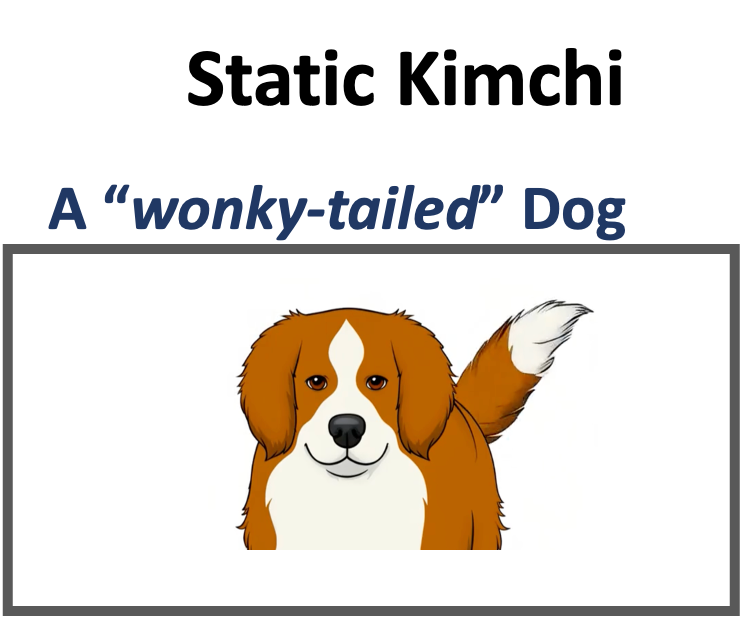
P1: Kimchi Frozen in Time
Chances are, we would catch her mid-wag and with a wonky little tail – maybe off-centered. But that isn’t the real Kimchi, it’s a static picture of a highly dynamic dog! A mix of all her tail-wagging moments smooshed into one.
Now, instead of a single photo, let’s study Kimchi a little more.

Active Kimchi

Lazy Kimchi
She is capable of performing two activities that seem to be independent. She can be “active” and move about or she can be “lazy” and sleep in her bed. And independently, she can wag her tail. Let’s have a look at the populations of these different states.
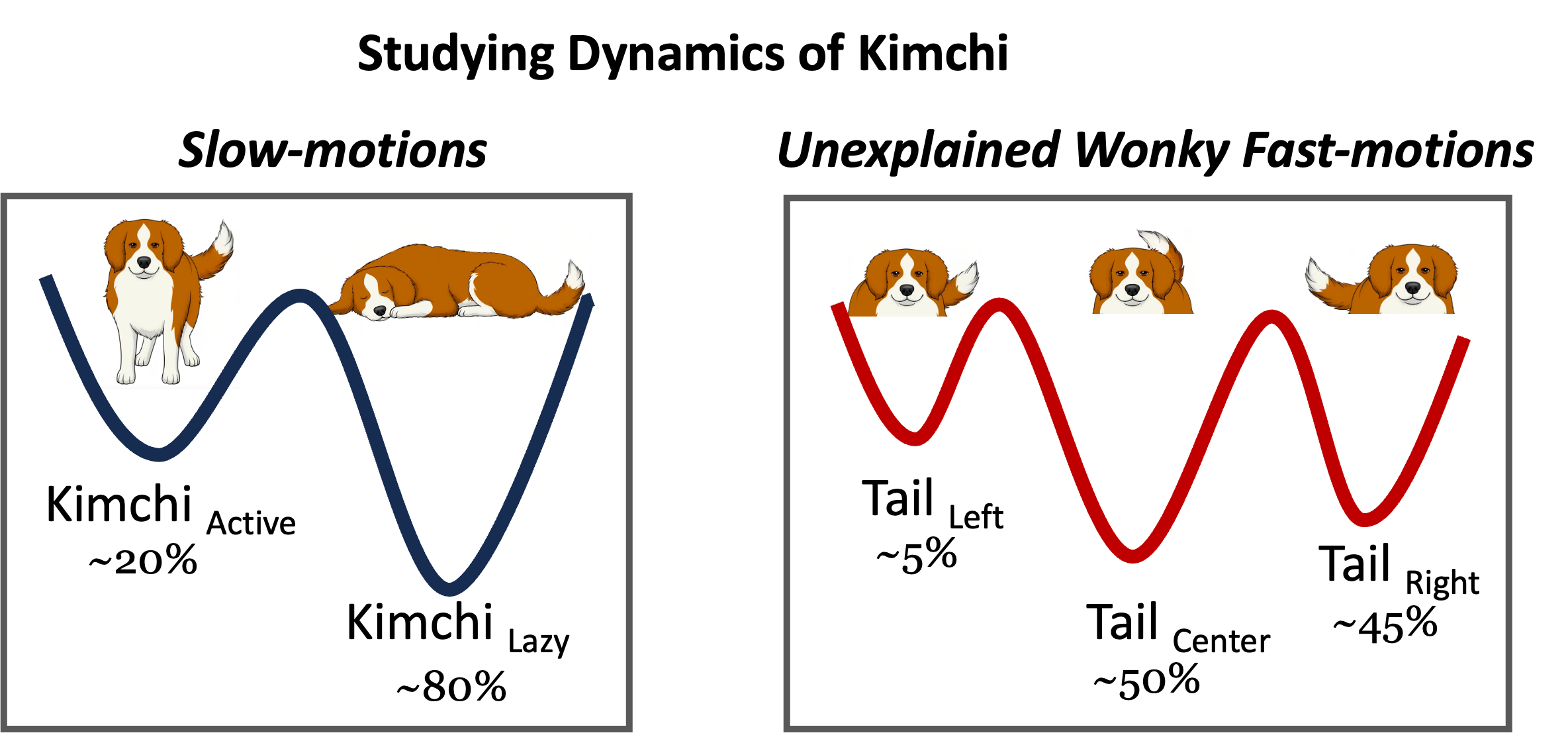
P2: Slow and Fast dynamics of Kimchi
Why does Kimchi’s tail refuse to wag on the left side? If you just average the tail positions without knowing whether she’s sitting or standing, you’d end up with something odd - a dog with a lopsided tail wag. A structural reasoning appears only when you factor in the macrostates of whether the dog is active or lazy.
When Kimchi is active, her tail goes from extreme left to center to the far right. Kimchi, when she is lazy and lying down, is structurally restricted in moving her tail. Now the tail can move only from the center to the right. But when you look closely, you see population shuffling. (Learning- While trying to study faster motions, we cannot forget the contributions from the slower interchanges between macrostates!)
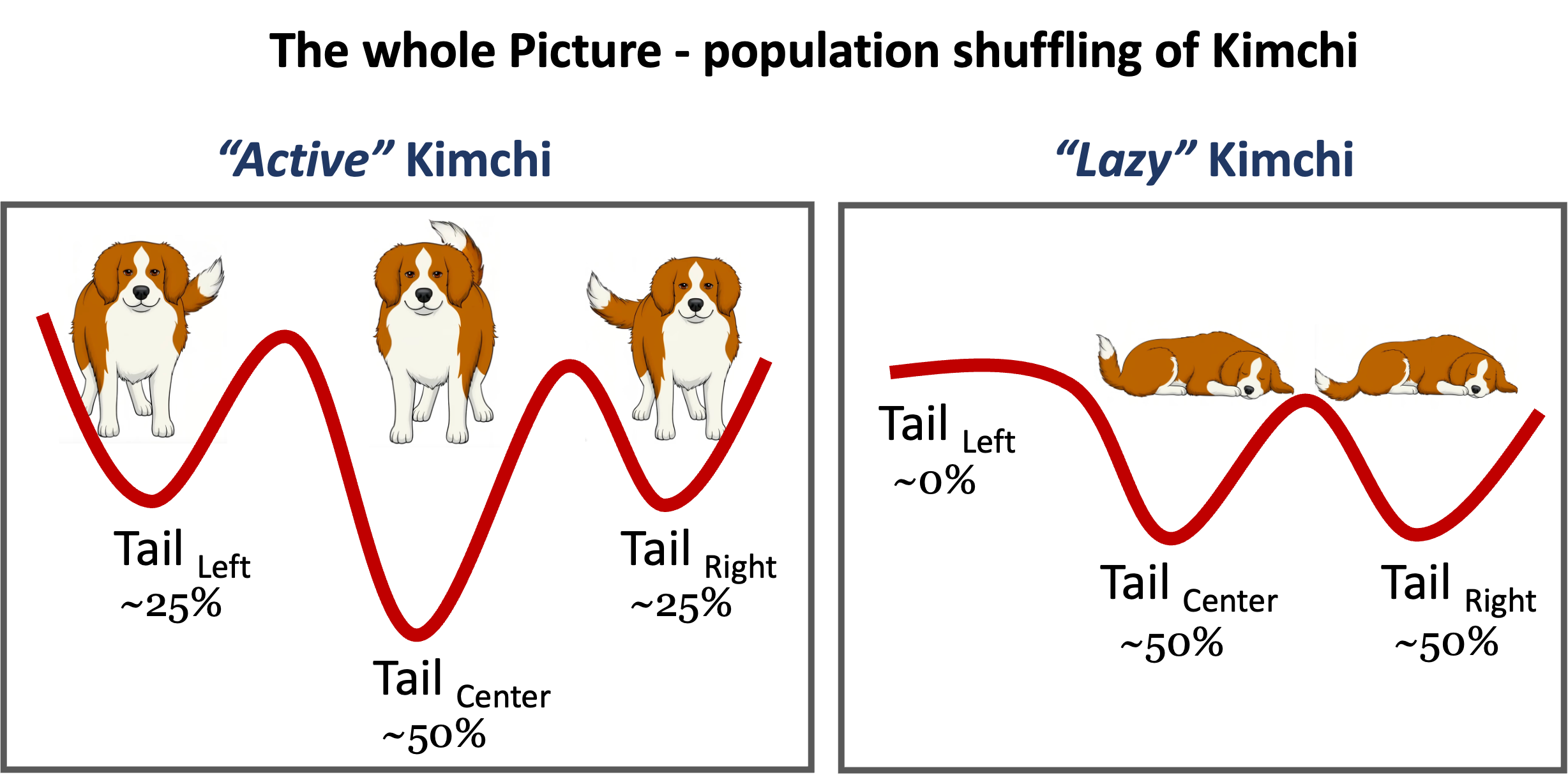
P3: Population shuffling explains the lopsided tail wag
Two macrostates arising from two conformations, like active and lazy states of the dog, can lead to redistribution of populations caused by faster motions like her wagging tail. If you were to simply measure the populations of the wagging tail states, you would get a population-weighted average that doesn’t really make sense, like in P2. But a clearer picture appears when you factor in the active and lazy macrostates (like in P3)!
Population Shuffling in Proteins!
This proposed phenomenon beautifully explains how the slower interconverting conformational changes in a protein can alter the energy landscapes for the fast-interconverting motions. Often, the interplay between motions and dynamics occurring at different timescales is overlooked, and perhaps it shouldn’t be… This study has been conducted on a very famous protein called ubiquitin. And you can read more about lopsided protein dynamics in the following papers!
- Population shuffling of protein conformations (2015) (DOI: 10.1002/anie.201408890)
- Population shuffling between ground and high energy excited states. (2015) (DOI: 10.1002/pro.2797)